





SPAB Magazine Spring 2023
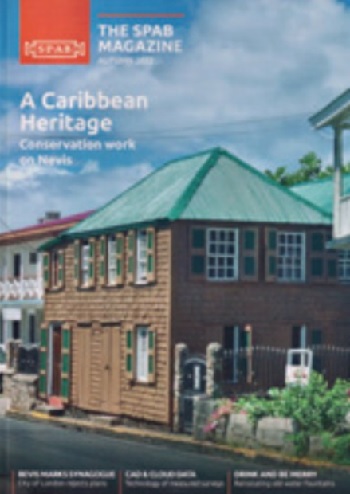
For those who have not had the opportunity to digest Historic England’s Listed Building Owners and Occupiers Survey for 2022, Matthew Slocombe highlights some telling statistics in the SPAB (Society for the Protection of Ancient Buildings) Magazine (Spring 2023). In some respects, the survey results are encouraging, with 89 per cent of residents feeling proud of the listed place in which they live, and 86 per cent concluding that they are able to keep on top of repair and maintenance issues.
However, while 81 per cent supported the concept of listed building consent, satisfaction with the operation of the system has fallen from 51 per cent in 2017 (the date of the last survey) to 35 per cent in 2022. This is despite only 15 per cent of respondents having had their listed building applications refused. Slocombe concludes that the response presumably reflects the perceived difficulties or both appropriately authoritative expertise and administration within the planning system. That is likely to come as no surprise to readers here.
What may also be of interest in this issue is an exploration of the philosophical arguments surrounding the treatment of Clandon Park, owned by the National Trust and gutted by fire in 2015. The then National Trust director Helen Ghosh said that Clandon would be rebuilt ‘in some shape or form’, sparking a vigorous debate on the merits of alternative approaches. Diametrically opposed arguments were voiced ranging from full restoration to accepting Clandon’s fate and leaving it as a ruin while spending the insurance money on conservation of other houses in the trust’s care.
An international design competition, held in 2017, was won by Allies and Morrison with a proposal to ‘restore, reimagine and rebuild’. Those proposals have now been significantly revised in the light of a growing understanding and appreciation of what survives, and what is achievable in terms of reinstating lost interiors. This shift in the National Trust’s thinking about how the house might best be used, interpreted and presented led to the launch of new proposals in July 2022.
It is now being argued that, post-fire, Clandon represents a new and exciting chapter in the house’s rich history. This has prompted a rethink of received knowledge and revised comprehension of the multifaceted nature of the materials and layers that make up the house, and acknowledgment and admiration for often unknown, but highly skilled minds and dexterous craftsmanship that had contributed to the building as a whole. Clearly this is proving to be a very long-drawn-out project, and it might be argued that the longer it continues, the more additional scholarship and further evidence might inform yet further revisions to the proposed renovation work.
Finally, Eleanor Jolliffe considers the emergence of architects, and the changing nature of their profession, particularly with reference to the 19th century; the founding of the RIBA and the SPAB; and the architects’ presently evolving role. The relationship between what prospective architects are taught about building construction and building history; and the specific needs of authenticity, appropriate heritage management, construction and the use of traditional materials, are aspects of conservation that the SPAB is particularly well placed to address.
This article originally appeared in the Institute of Historic Building Conservation’s (IHBC’s) Context 176, published in June 2023. It was written by Bob Kindred MBE.
--Institute of Historic Building Conservation
Related articles on Designing Buildings
IHBC NewsBlog
IHBC sponsors Gardens Trust event 23-4 Sept 2026
.jpeg)
'Learning from the Past, Shaping the Future’ takes place in Milton Keynes
Renovations to Frank Lloyd Wright's Fallingwater complete
.jpg)
World Heritage Preserved project opens house for tours again
Shakespeare Birthplace Trust places Hall's Croft on HAR Register
Stratford-upon-Avon home of Shakespeare's daughter is 'At Risk'
Lady Grange’s House repaired on St Kilda
.jpg)
National Trust for Scotland repairs stone cleit with link to famous island resident
Griff Rhys Jones on BBC Radio 4 Today programme
,_Green_Lane,_Derby.jpg)
The Victorian Society’s President unveiled its latest Top Ten Endangered Buildings 2026.
Need a MATE? Book your place now.

IHBC offers free webinars on applying for IHBC accreditation (Full & Associate).
UK Stained Glass Repository finds windows new homes
How are stained glass windows are rescued, stored and repurposed?
APPGEBE report sets high aims for quality
'Government must not sacrifice quality in drive to build 1.5m homes'
New measures protect Historic Shipwrecks from heritage crime

Underwater cultural heritage benefits from new HE guidance
How could the City of London skyline look in 6 years' time?

Visualisation shows approved planning applications as completed buildings
National Trust for Scotland calls for VAT cuts

Heritage neglect is encouraged by current policies
IHBC's 'Context' Issue 186 features Industrial Heritage
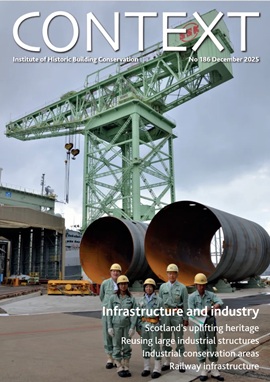
IHBC's members' journal reports on the challenges of conserving infrastructure
Book now for IHBC Annual School 2026

IHBC Annual School is taking place 18-20 June 2026 in Newcastle
RICHeS Research Infrastructure offers ‘Full Access Fund Call’
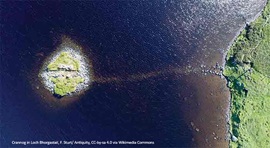
RICHeS offers a ‘Help’ webinar on 11 March
Latest IHBC Issue of Context features Roofing
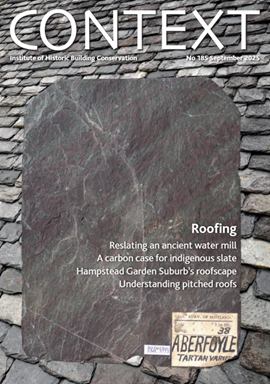
Articles range from slate to pitched roofs, and carbon impact to solar generation to roofscapes
Three reasons not to demolish Edinburgh’s Argyle House

Should 'Edinburgh's ugliest building' be saved?
IHBC’s 2025 Parliamentary Briefing...from Crafts in Crisis to Rubbish Retrofit
IHBC launches research-led ‘5 Commitments to Help Heritage Skills in Conservation’
How RDSAP 10.2 impacts EPC assessments in traditional buildings

Energy performance certificates (EPCs) tell us how energy efficient our buildings are, but the way these certificates are generated has changed.